
Introduction
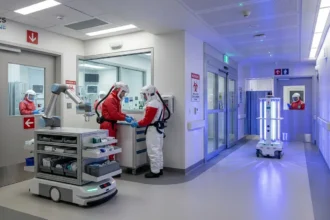
Hospital robot navigation systems are essential for enabling autonomous robots to move safely through complex healthcare environments. These systems use SLAM and LiDAR technologies to map surroundings, detect obstacles, and operate efficiently in hospitals.
Hospital robots use SLAM (Simultaneous Localization and Mapping) and LiDAR sensors to map environments, detect obstacles, and navigate safely in real time, enabling reliable automation, improving efficiency, and reducing human workload in healthcare settings.
What Are Navigation Systems in Hospital Robots?
Navigation systems allow robots to:
- Move safely through hospital corridors
- Avoid collisions with staff and equipment
- Understand and adapt to changing layouts
These systems power:
- Cleaning robots
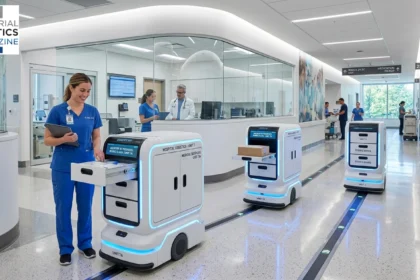
- Delivery robots
- Disinfection robots
- Service robots in clinics and hospitals
Without advanced navigation, robots cannot operate safely in healthcare environments.
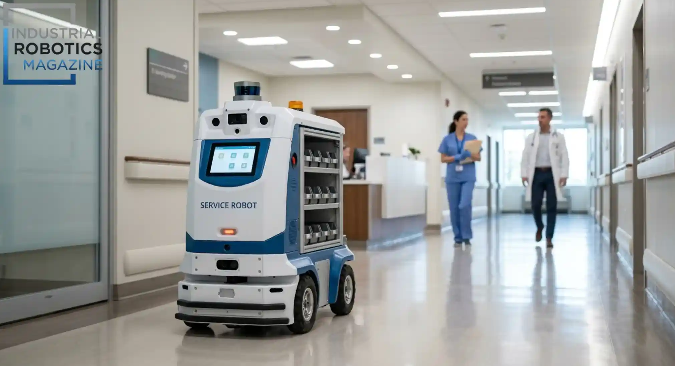
How Do Hospital Robots Navigate?
Step-by-step process:
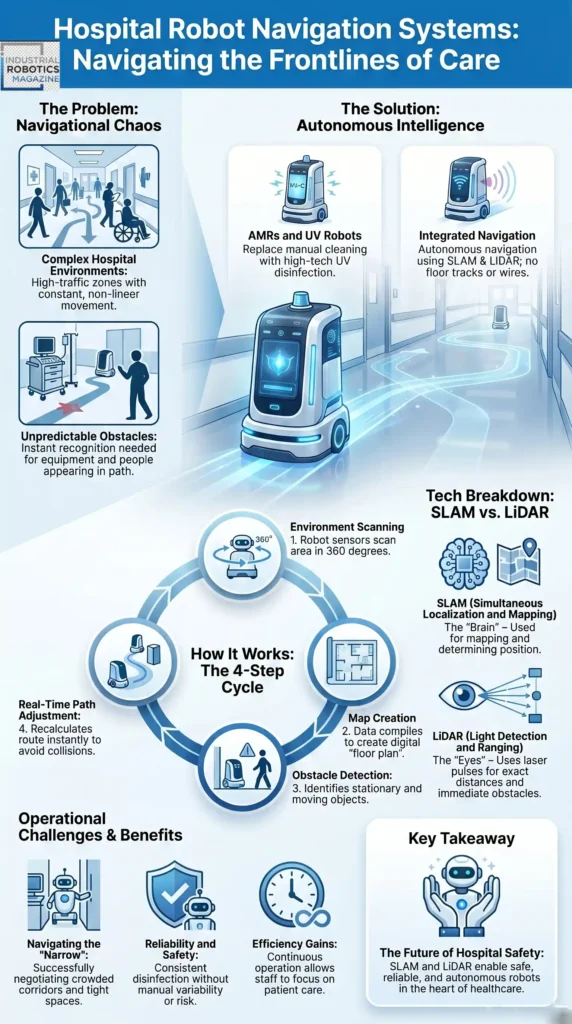
- Sensors scan the environment
- SLAM creates a real-time map
- LiDAR detects obstacles and distances
- The robot continuously updates its path
This allows robots to move autonomously without human control.
What Is SLAM in Hospital Robotics?
SLAM (Simultaneous Localization and Mapping) allows robots to:
- Build maps of hospital spaces
- Track their location continuously
- Adjust to new or changing environments
Why it matters:
Hospitals are dynamic rooms change, people move, and layouts shift.
SLAM ensures robots can adapt instantly.
What Is LiDAR and How Does It Help?
LiDAR (Light Detection and Ranging) uses laser sensors to measure distances and detect objects.
Key benefits:
- High precision navigation
- Accurate obstacle detection
- Works in low-light environments
LiDAR acts as the robot’s “eyes,” ensuring safe movement in crowded hospital settings.
SLAM vs LiDAR: Key Differences
| Feature | SLAM | LiDAR |
|---|---|---|
| Function | Mapping + positioning | Distance sensing |
| Type | Software system | Hardware sensor |
| Role | Navigation logic | Environmental detection |
| Importance | Core intelligence | Sensor accuracy |
Real-World Challenges in Hospitals
Hospital environments are harder than most robotics settings due to:
- Narrow corridors
- Constant human movement
- Equipment blocking paths
- Emergency situations
Why this matters:
Robots must make real-time decisions or risk failure.
Real-World Example: Hospital Robot Deployment
Hospitals using autonomous delivery robots powered by SLAM and LiDAR have reported:
- Faster internal logistics
- Reduced staff workload
- Safe navigation in crowded areas
Companies like Aethon (TUG robots) and Xenex Disinfection Services demonstrate how navigation systems enable practical, real-world deployment.
Benefits of Advanced Navigation Systems
- Improved efficiency in hospital operations
- Reduced dependency on manual labor
- Enhanced patient and staff safety
- Reliable automation in complex environments
When Do Hospitals Use These Systems?
Navigation systems are used in:
- Cleaning and disinfection robots
- Medicine and supply delivery robots
- Patient assistance robots
They form the foundation of modern hospital automation.
Conclusion
SLAM and LiDAR are essential technologies that allow hospital robots to function safely and effectively in complex environments. By enabling real-time mapping, obstacle detection, and adaptive navigation, these systems make healthcare automation reliable and scalable.
FAQ
What is SLAM in hospital robots?
SLAM allows robots to map environments and track their position in real time.
How does LiDAR help navigation?
LiDAR detects obstacles and improves accuracy using laser-based sensing.
Are hospital robots fully autonomous?
Most operate autonomously but may require supervision.
Why is hospital navigation difficult?
Dynamic environments with people and equipment create constant challenges.
Do all hospital robots use SLAM and LiDAR?
Most advanced robots use a combination of both technologies.









One Comment