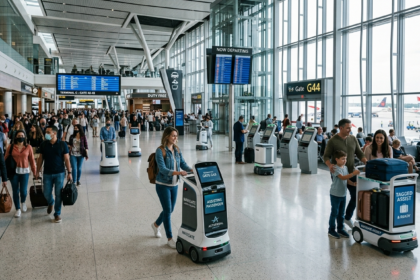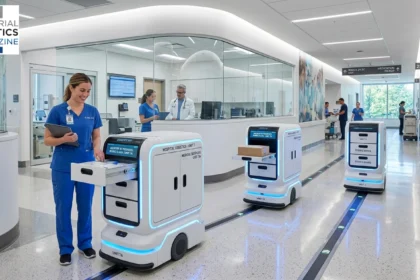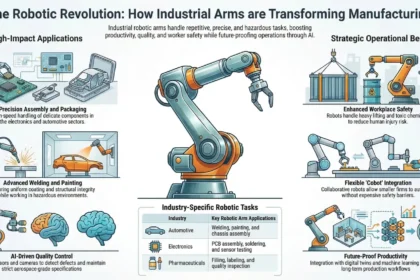
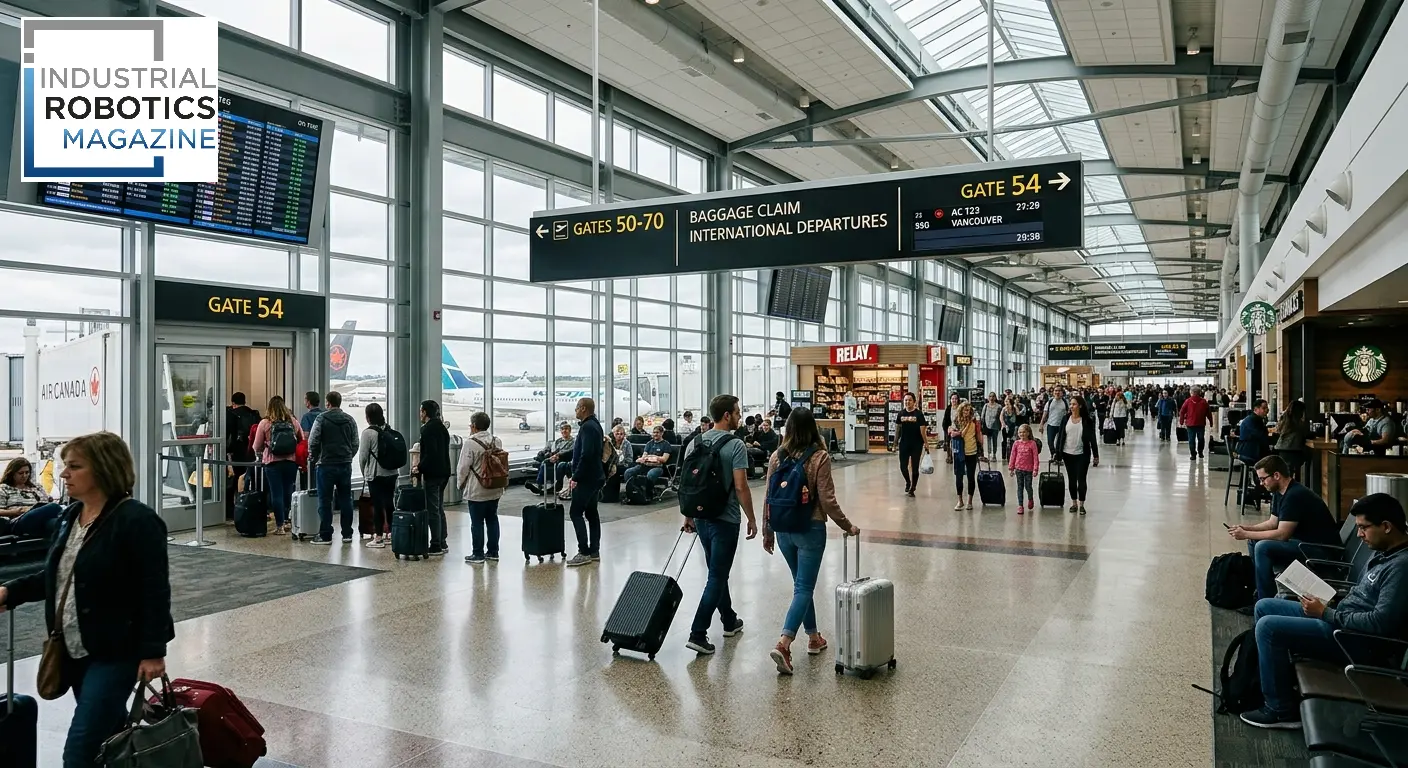
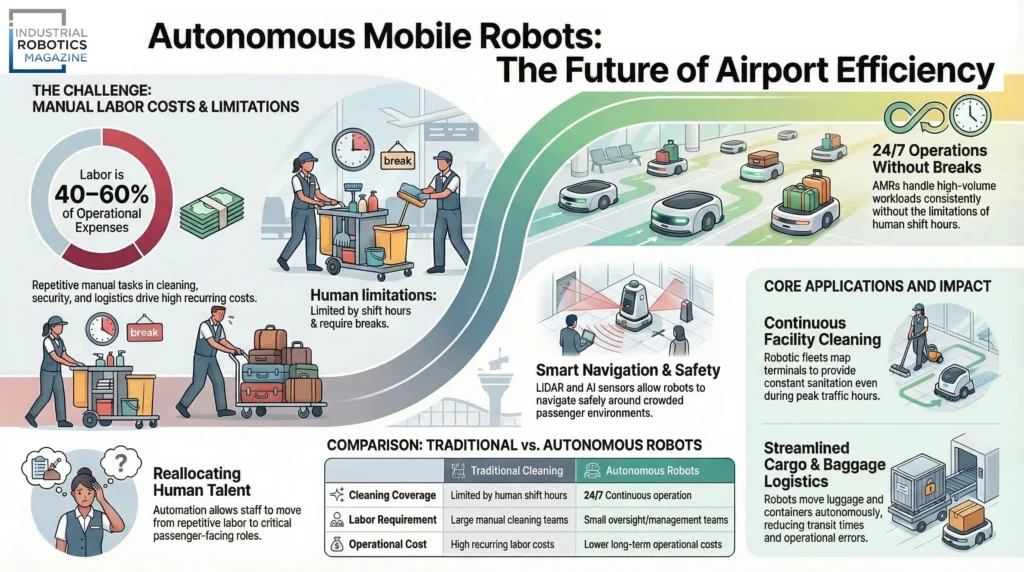
Airports operate like small cities. Every day, thousands of repetitive tasks—baggage transport, cleaning, security patrols, and logistics—require significant manual labor. According to industry estimates, labor costs can represent 40–60% of airport operational expenses.
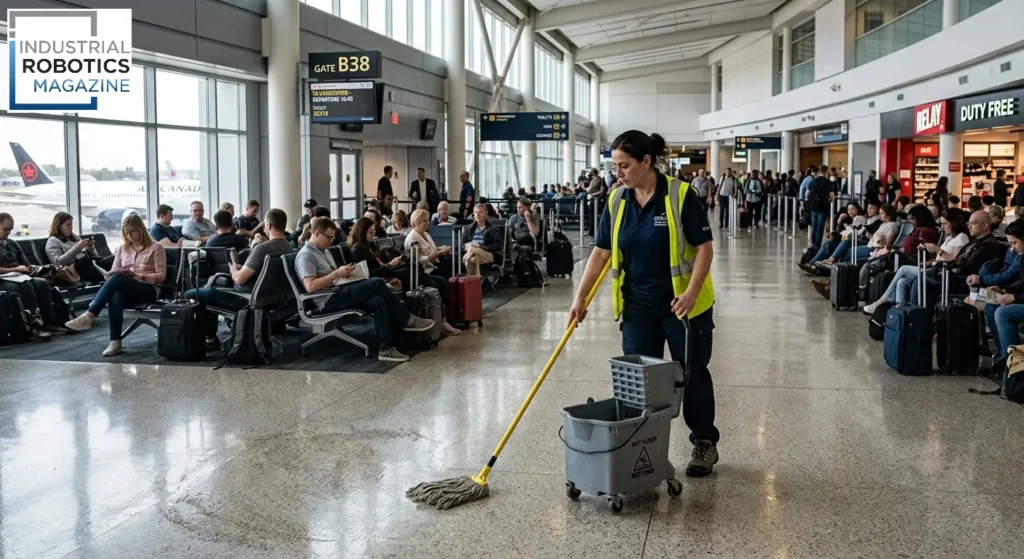
Autonomous mobile robots (AMRs) help airports reduce costs by automating repetitive tasks such as baggage handling, cleaning, security patrols, and inventory transport. By minimizing manual labor, improving operational efficiency, and running continuously, these robots streamline airport operations while reducing long-term labor and maintenance costs.
The result? Faster operations, lower costs, and improved passenger experiences.
What Are Autonomous Mobile Robots?
Autonomous mobile robots (AMRs) are intelligent machines designed to navigate complex environments without direct human control. Unlike traditional industrial robots that operate in fixed positions, AMRs use sensors, cameras, and AI-powered navigation to move freely around facilities.
In airports, these robots can:
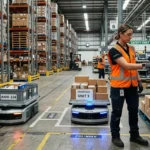
- Transport baggage or cargo between terminals
- Clean floors and maintain facilities
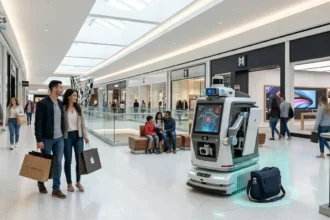
- Conduct security monitoring
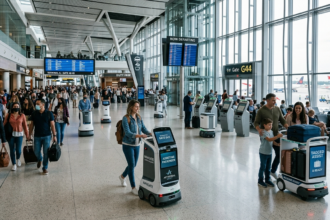
- Assist with passenger services
- Manage inventory in airport warehouses
Because airports are large, dynamic environments, mobility and adaptability are critical. AMRs excel here because they can safely navigate around passengers, workers, and obstacles.
Key Technologies Behind AMRs
Modern airport robots rely on several advanced technologies:
- LiDAR and vision sensors for navigation
- AI-driven mapping and path planning
- Fleet management software for coordination
- Real-time data analytics for performance monitoring
These capabilities allow AMRs to operate 24/7 with minimal supervision.
How Do Autonomous Mobile Robots Reduce Costs at Airports?
Cost reduction is the biggest driver behind robotics adoption. Airports face rising labor costs, staffing shortages, and increasing passenger demand.
Here’s how AMRs address those challenges.
1. Automating Repetitive Tasks
Many airport operations involve routine work that doesn’t require human decision-making.
Examples include:
- Moving baggage carts
- Delivering maintenance supplies
- Cleaning large terminal floors
- Transporting cargo between warehouses
By assigning these repetitive operations to robots, airports reduce dependency on manual labor while improving productivity.
2. Lower Labor Costs
Airports often require multiple shifts of workers to maintain operations around the clock.
AMRs offer several advantages:
- Operate 24/7 without breaks
- Reduce staffing requirements
- Handle high-volume workloads consistently
This doesn’t eliminate human jobs—it reallocates workers to higher-value roles, such as passenger services or security oversight.
3. Improved Operational Efficiency
Autonomous robots improve the flow of airport operations by reducing delays.
For example:
- Baggage delivery robots minimize transfer times
- Cleaning robots maintain terminals continuously
- Security patrol robots monitor areas autonomously
This leads to faster turnaround times for flights and better passenger experiences.
4. Reduced Operational Errors
Humans are prone to fatigue and mistakes, especially in repetitive environments.
Robots help eliminate issues like:
- Misplaced baggage
- Missed cleaning cycles
- Inventory errors in airport warehouses
Consistency translates directly into lower operational costs and fewer service disruptions.
Real-World Example: Autonomous Robots in Airport Operations
Airport Robotics Case Study
Several global airports have already deployed AMRs to improve efficiency.
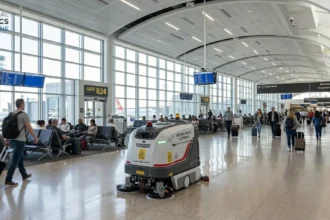
One notable example is autonomous cleaning robots used in large terminals.
These robots can:
- Map entire airport floors
- Clean continuously during operational hours
- Avoid passengers and obstacles automatically
The impact has been measurable.
| Metric | Traditional Cleaning | Autonomous Robots |
|---|---|---|
| Cleaning Coverage | Limited by shift hours | 24/7 operation |
| Labor Requirement | Large cleaning teams | Smaller oversight teams |
| Operational Cost | High recurring labor | Lower long-term cost |
| Consistency | Human-dependent | Automated scheduling |
Airports adopting robotic cleaning fleets have reported significant labor cost reductions and improved facility cleanliness.
What Airport Operations Can Be Automated?
Autonomous robots are increasingly used across multiple airport departments.
Baggage Handling
Robots transport luggage between terminals, storage areas, and aircraft loading zones.
Benefits include:
- Faster baggage movement
- Reduced physical strain on workers
- Lower risk of lost luggage
Facility Cleaning
Large airport terminals require constant cleaning due to high passenger traffic.
Cleaning robots can:
- Vacuum and scrub floors
- Sanitize high-traffic areas
- Work during peak hours without disruption
Security Patrols
Security robots provide an additional layer of monitoring.
They can:
- Patrol terminals and parking areas
- Detect suspicious activity
- Send alerts to human security teams
Cargo and Inventory Logistics
Airports handle massive volumes of cargo daily.
AMRs streamline logistics by:
- Moving cargo containers
- Managing warehouse inventory
- Coordinating deliveries across airport facilities
Why Airports Are Rapidly Adopting Robotics
Several industry trends are accelerating robot adoption.
Labor Shortages
Many airports struggle to recruit workers for physically demanding roles.
Robots help fill those gaps.
Growing Passenger Demand
Global air travel continues to rise, increasing pressure on airport infrastructure.
Automation enables airports to scale operations without dramatically increasing labor costs.
Smart Airport Initiatives
Many airports are investing in smart infrastructure—AI, IoT, and robotics—to modernize operations.
Autonomous robots are a key part of this digital transformation.
Challenges of Deploying Autonomous Robots
Despite their advantages, robotic deployments still face challenges.
High Initial Investment
The upfront cost of purchasing and deploying robots can be significant.
However, many airports recover this investment through long-term labor savings.
Integration with Existing Systems
Robots must integrate with airport logistics systems, security protocols, and facility management software.
This requires careful planning and infrastructure upgrades.
Safety and Compliance
Robots operating in crowded environments must meet strict safety standards to avoid accidents.
Modern AMRs address this through advanced sensors and obstacle detection systems.
The Future of Robots in Airports
Autonomous robots will likely play an even bigger role in airport automation.
Emerging developments include:
- Passenger assistance robots
- Autonomous baggage vehicles
- AI-powered maintenance robots
- Robotic cargo logistics systems
As technology advances, airports may become highly automated ecosystems where robots handle most operational tasks behind the scenes.
Final Verdict
Airports are under constant pressure to improve efficiency while controlling operational costs. Autonomous mobile robots provide a powerful solution by automating repetitive operations, reducing manual labor, and improving consistency across airport workflows.
From baggage transport to facility cleaning and security patrols, robots are already transforming airport infrastructure. As adoption grows, autonomous robotics will likely become a core component of modern airport operations worldwide.
For airports looking to scale efficiently, the question is no longer whether to deploy robots—but how quickly they can implement them.
FAQ: Autonomous Robots in Airports
1. How do autonomous mobile robots work in airports?
Autonomous mobile robots use sensors, AI navigation, and mapping technologies to move through airport environments safely. They perform tasks like cleaning floors, transporting baggage, and moving cargo without direct human control.
2. Are robots replacing airport workers?
No. Robots primarily automate repetitive tasks that require manual labor. Human workers are typically reassigned to higher-value roles such as passenger services, monitoring, and system management.
3. What types of robots are commonly used in airports?
Airports use several types of robots, including:
- Cleaning robots
- Baggage transport robots
- Security patrol robots
- Logistics and cargo robots
4. How much can airports save using autonomous robots?
Savings vary depending on deployment scale, but many airports report significant reductions in labor costs and improved operational efficiency, particularly in cleaning and logistics operations.
5. Are autonomous robots safe in crowded airports?
Yes. Modern robots use advanced sensors, obstacle detection systems, and AI navigation to safely operate around passengers and staff.