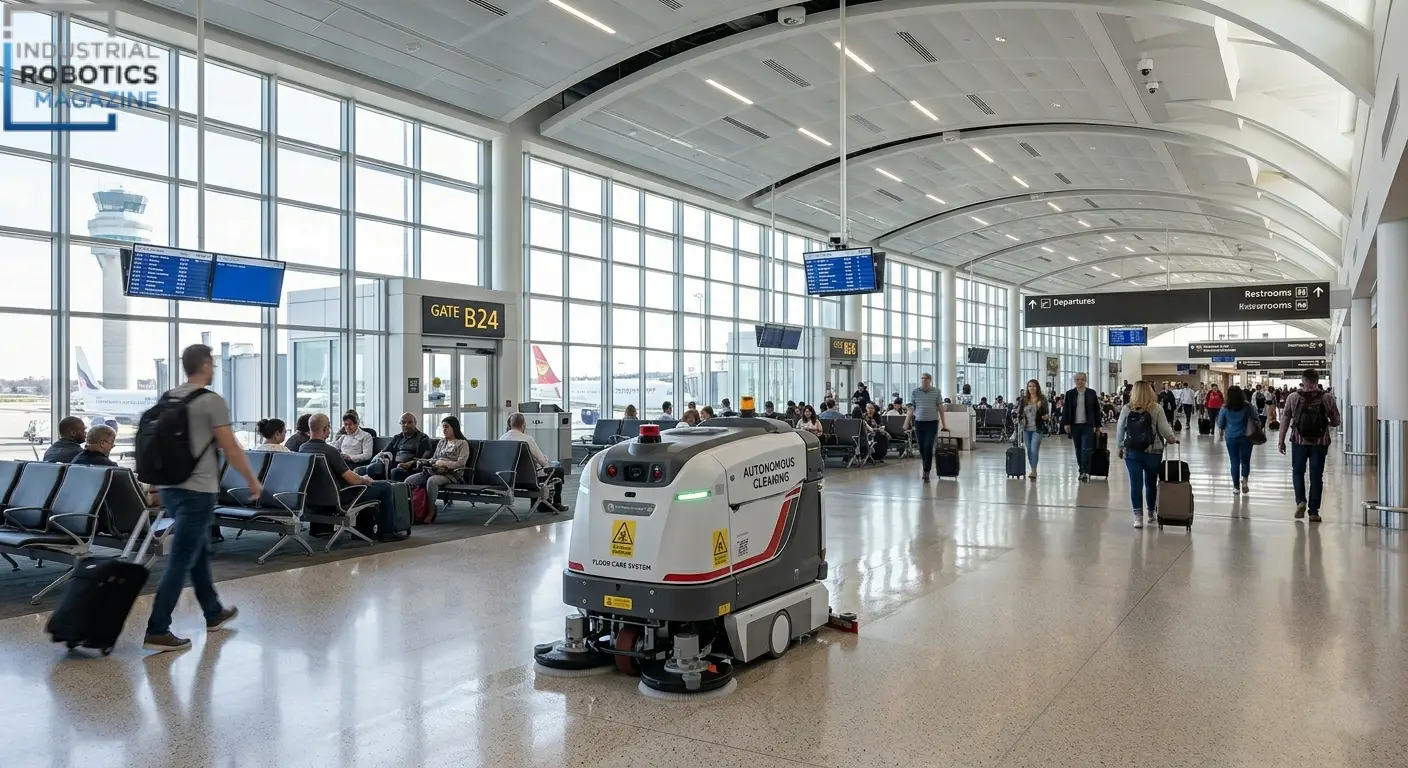
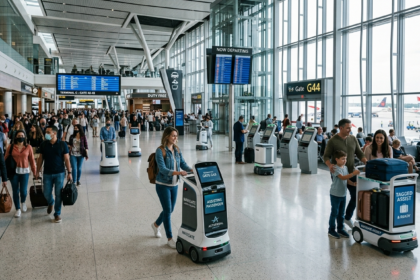
Autonomous airport cleaning robots are becoming an important solution for airports that need cleaner terminals, safer public spaces, and more efficient facility operations. As passenger traffic increases, airports need reliable cleaning systems that can handle large floors, busy gates, food courts, corridors, and baggage claim areas without slowing down daily operations.
Why Airports Need Autonomous Airport Cleaning Robots
Airport cleaning is much harder than regular commercial cleaning. A mall or office building may have busy hours, but airports often operate for long periods with little downtime. Some airports run almost 24/7, meaning cleaning must happen while passengers are still moving through the building. For a broader look at airport automation, read our guide on smart airport operations.
The main problem is not just dirt. The real problem is scale.
Airports have:
- Long corridors
- Wide terminal floors
- Boarding gates
- Food courts
- Security line areas
- Washroom entrances
- Baggage claim zones
- Lounges
- Parking walkways
- Cargo and staff-only areas
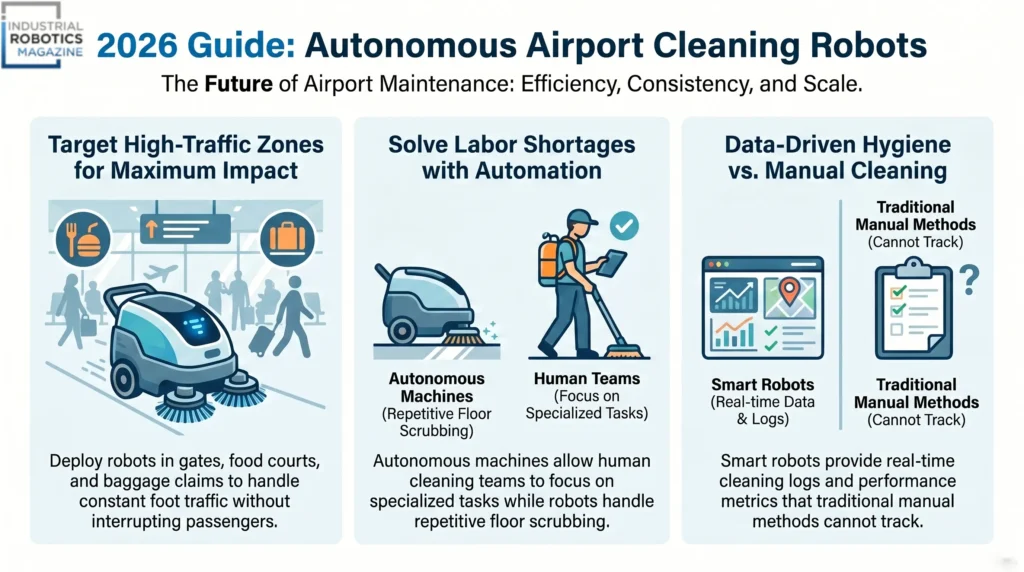
Cleaning all these areas manually takes time, labour, and strong coordination. This is where autonomous airport cleaning robots become valuable. They handle repetitive floor cleaning while human workers focus on detailed cleaning, urgent messes, washrooms, trash removal, and passenger-facing tasks.
How Autonomous Airport Cleaning Robots Work
Autonomous airport cleaning robots use sensors, cameras, mapping software, and artificial intelligence to move safely through airport environments. After the robot maps an area, it can follow assigned cleaning routes, avoid obstacles, and complete cleaning tasks with limited human control.
Most modern airport cleaning robots can:
- Map airport cleaning zones
- Follow scheduled cleaning routes
- Avoid passengers, luggage, chairs, and walls
- Clean floors automatically
- Return to charging stations
- Track cleaning performance
- Send maintenance alerts
- Provide digital cleaning reports
This is important because airport managers need more than “the floor looks clean.” They need proof. Digital reports can show where the robot cleaned, when it cleaned, and how much area was covered.
Airport Cleaning Robot Use Cases
| Airport Area | Robot Use Case | Main Benefit |
|---|---|---|
| Terminal floors | Autonomous scrubbing and vacuuming | Keeps large walking areas clean |
| Boarding gates | Cleaning between flight waves | Improves passenger comfort |
| Baggage claim | Cleaning around luggage zones | Handles heavy foot traffic |
| Food courts | Cleaning crumbs, spills, and dirt | Supports hygiene in dining areas |
| Long corridors | Repeated route cleaning | Saves staff time |
| Security areas | Cleaning queue zones | Maintains high-traffic cleanliness |
| Lounges | Scheduled cleaning during quiet periods | Supports premium service standards |
| Washroom entrances | Floor cleaning near restroom zones | Reduces dirt and moisture buildup |
| Parking walkways | Cleaning indoor access paths | Improves first impressions |
| Cargo areas | Industrial floor cleaning | Supports back-end airport operations |
Benefits of Autonomous Airport Cleaning Robots
1. More Consistent Cleaning
Human cleaners can do excellent work, but consistency is hard in a busy airport. Staff may be pulled away for spills, washrooms, trash, or urgent cleaning requests.
Robots help by completing the same cleaning routes again and again. They do not forget zones, skip areas because they are tired, or get distracted by other tasks. That consistency is one of the biggest reasons airports are adopting robotic floor cleaners.
2. Reduced Pressure on Cleaning Staff
A bad sales pitch says robots replace workers. That is lazy and short-sighted.
The stronger argument is that robots support cleaning teams. Autonomous airport cleaning robots take over repetitive floor work so staff can focus on jobs that need human judgment, speed, and detail.
For example, human cleaners are still needed for:
- Washroom cleaning
- Spill response
- Trash removal
- Seat and table cleaning
- Glass cleaning
- Disinfection tasks
- Customer-facing cleaning requests
- Areas robots cannot reach
This makes the cleaning team more productive instead of simply overworked.
3. Better Passenger Experience
Passengers notice cleanliness. Dirty floors, sticky food courts, overflowing garbage, and messy boarding areas make an airport feel poorly managed.
Clean spaces create a better first impression. They also make passengers feel safer and more comfortable, especially in high-traffic areas like gates, lounges, and baggage claim.
Autonomous cleaning machines help airports maintain a cleaner appearance throughout the day, not just after overnight cleaning.
4. Useful Cleaning Data
One major advantage of smart airport cleaning solutions is reporting. Many robots can track where they cleaned, how long they worked, and how much space they covered.
This helps airport facility managers:
- Monitor cleaning performance
- Improve staff planning
- Identify high-traffic problem areas
- Prove cleaning tasks were completed
- Adjust schedules based on real usage
This matters because cleaning is not just about appearance. It is also about accountability.
5. Better Use of Low-Traffic Hours
Airports often have quieter periods late at night or early in the morning. Autonomous airport cleaning robots can clean large areas during these times before passenger traffic increases again.
This allows airport teams to prepare terminals for the next rush without needing every task to be done manually.
Challenges of Autonomous Airport Cleaning Robots
Autonomous airport cleaning robots are useful, but they are not magic. Treating them like a perfect solution is bad thinking.
The main challenges include:
High Upfront Cost
Robots require investment. Airports must consider purchase price, maintenance, software, training, support, and replacement parts.
Complex Airport Layouts
Airports change constantly. There may be construction zones, temporary signs, moving queues, furniture changes, and sudden crowding. Robots need proper setup and monitoring to work well.
Human Supervision Is Still Needed
Robots still need people. Staff must refill water, empty tanks, check cleaning quality, manage errors, and maintain the machines.
Passenger Safety
Airport robots must move safely around people, luggage, children, wheelchairs, and strollers. Strong sensors and safe operating speeds are essential.
Not Every Area Is Robot-Friendly
Robots are best for large, open, repetitive spaces. Tight corners, stairs, cluttered areas, and detailed cleaning tasks still require human workers.
Are Autonomous Airport Cleaning Robots Worth It?
Yes, but only if the airport has a clear plan.
Buying robots just to look futuristic is a trash strategy. It wastes money and produces weak results. The robot needs a real job, assigned zones, trained staff, measurable goals, and management support.
Autonomous airport cleaning robots are most valuable when an airport has:
- Large floor areas
- High passenger traffic
- Long operating hours
- Repetitive cleaning routes
- Labour shortages
- Strict cleanliness standards
- Need for cleaning reports
For small airports, the decision depends on cost, layout, traffic levels, and cleaning workload. For large airports, the business case is much stronger.
Future of Airport Cleaning Robots
The future of airport cleaning will likely include smarter robots with better navigation, longer battery life, automatic charging, improved reporting dashboards, and stronger integration with airport facility management systems.
Airports may also combine cleaning robots with:
- Security patrol robots
- Passenger assistance robots
- Delivery robots
- Baggage handling robots
- Inspection robots
This creates a smarter airport environment where robots handle repetitive operational tasks while humans focus on service, safety, and decision-making.
FAQs About Autonomous Airport Cleaning Robots
What are autonomous airport cleaning robots?
Autonomous airport cleaning robots are self-driving cleaning machines that clean airport floors, terminals, corridors, gates, baggage areas, and other high-traffic spaces with limited human control.
Do airport cleaning robots replace human cleaners?
No. They support human cleaning teams by handling repetitive floor cleaning. Human staff are still needed for washrooms, spills, trash removal, detailed cleaning, inspections, and customer-facing cleaning tasks.
Where are airport cleaning robots most useful?
They are most useful in terminal floors, long corridors, baggage claim areas, food courts, boarding gates, lounges, and other large open spaces with repeated cleaning needs.
Are autonomous cleaning robots safe around passengers?
Yes, when properly designed and operated. They use sensors, cameras, mapping systems, and obstacle detection to avoid passengers, luggage, walls, and furniture.
What types of cleaning can airport robots do?
Most airport cleaning robots handle floor scrubbing, vacuuming, sweeping, and polishing. Some advanced models may also support disinfection or specialized cleaning tasks.
How do airports benefit from cleaning robots?
Airports benefit through more consistent cleaning, reduced pressure on staff, better passenger experience, digital cleaning reports, and improved use of low-traffic cleaning hours.
Are autonomous airport cleaning robots expensive?
Yes, the upfront cost can be high. However, the value depends on airport size, traffic volume, labour costs, cleaning needs, and how often the robot is used.
Can cleaning robots work during airport operating hours?
Yes. Many robots can work during active hours, but they must operate safely around passengers. Airports may also schedule them during quieter periods to avoid congestion.
What is the biggest limitation of airport cleaning robots?
The biggest limitation is that they cannot handle every cleaning task. They are best for repetitive floor cleaning, while detailed cleaning still requires human staff.
Are airport cleaning robots good for small airports?
They can be, but small airports must carefully compare cost against cleaning workload. Robots make the most sense when there is enough repetitive floor cleaning to justify the investment.
Final Verdict
Autonomous airport cleaning robots are a smart investment for airports with large spaces, heavy passenger traffic, and constant cleaning demands. They improve consistency, reduce repetitive labour, support cleaning teams, and give facility managers better data.
But they are not a miracle fix. If an airport buys them without a clear plan, the investment becomes weak fast. The strongest approach is to use robots for large, repetitive floor-cleaning routes while human staff focus on detailed, urgent, and passenger-sensitive cleaning tasks.
For modern airports, autonomous cleaning robots are not just futuristic technology. They are becoming a practical part of cleaner, safer, and more efficient airport operations.

One Comment